PJ Harvey: Sex and Bile and Rock and Roll
Jim Arundel, Melody Maker, 8 February 1992
IT'S SUNDAY AFTERNOON, grey and bitter and it looks like rain. Your flatmate, Lisa, and her gangly boyfriend, Ben, are in her room. They're burning incense. Some of its sweet tang has travelled down the hall as far as your bed-sitting room.
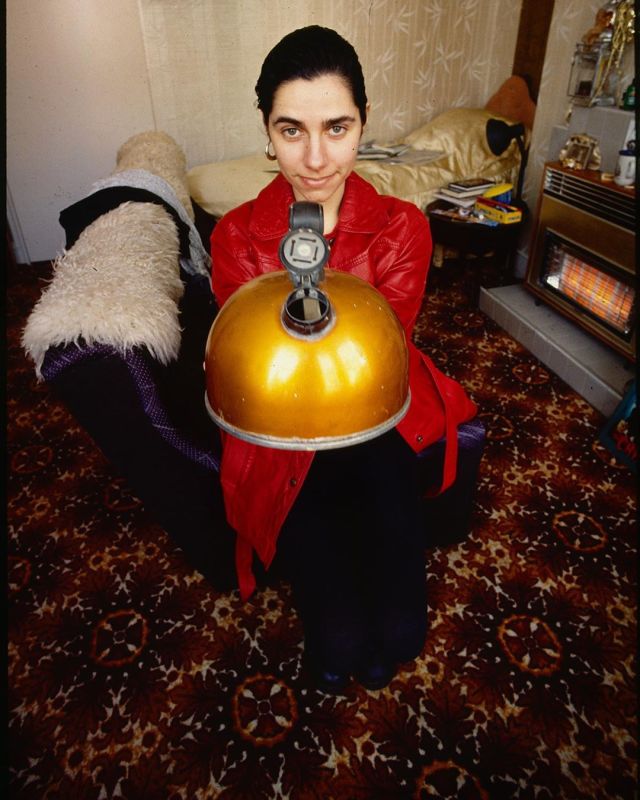
You have two panels of the gas fire alight and the sofa is up close to it. The room is tidy. The single bed is made, the duvet is plumped up, the gold coverlet is smoothed out. Your collection of fun-fur jackets is on a rail in the opposite corner. Your stereo is under the window. There's a metallic orange kettle sitting incongruously on top of one of the speakers. You are playing an album of readings-to-music by William Burroughs. It's a present for a friend and you're taping it before you give it to them.
You are dressed, as you often are, entirely in black. You are writing the titles of the album tracks onto the blank cassette box. You are 22 years old. You are P.J.Harvey and you are about to give your fifteenth interview – this time for your first major feature. The doorbell rings.
Can you feel your life changing?
"Yes, definitely. It's getting a lot faster. I'm sure it'll get a lot worse. So far I've managed to cope with it okay, although there are times when I've been really drained, become really ill. I'll just have to make sure I look after myself."
Polly Harvey is staring at a bright future. The three-piece band that bears her name has been visible for less than a year but has already found a cosy niche in the affections of a diverse array of pop pundits – people like John Peel, Loz of Kingmaker, Island Records and your soaraway Maker – not to mention a permanent residence in the indie charts with the magnificent debut single, 'Dress'. Names like Patti Smith, Chrissie Hynde, Marianne Faithful and Throwing Muses have been evoked. 'Dress' shares something with all of them, its brooding, tensile strength and biting wit focused on the absurdity of the mating ritual: "Must be some way I can dress to please him". Sex and bile and rock and roll. It's been a long while since it was done so well.
The follow-up single, 'Sheela-na-gig' (another fireball of joyous turmoil) is due any minute, to be swiftly followed by the debut album, Dry, both for Too Pure records. And the band is already signed to Island for major label distribution thereafter.
Three of us on this paper realised last week that we'd spent almost a day and a half solidly discussing P.J.Harvey, her songs and her place in the modern swirl. Then we started discussing why we were discussing her so much. We reckoned our excitement stems from an instinctive feeling that this moment in time, this decade, this generation, needs words and sounds like the things she brings. Quite a chance, her timing is perfect. She has the potential to mean a very great deal to a very large number of people. It's just a feeling you have.
Polly Harvey was raised in a Dorset village nine miles from the Yeovil studios where 'Dress' was recorded. Her father makes a living quarrying stone and her mother works with it, carving sculptures and engraving date-stones. Polly, and her older brother Saul, grew up in a house full of blues. Her mother used to arrange for R&B bands to play locally. Musicians were always around. In fact, an extension was built onto the Harvey home to accommodate visiting musicians.
At a show in Salisbury, in a church converted into an arts centre, I am introduced to Mr & Mrs Harvey who have made the 300-mile round trip to see their daughter play in the chilly venue. The first impressions are that mum is the garrulous half of the couple, talkative and youthfully dressed in tee-shirt and printed leggings. She has a soft, animated face. Dad seems to be more of the solid, silent artisan-in-denim type. It's clear that Polly Harvey's dark, angular looks come from his side of the family.
"I had a very stable upbringing," she tells me later. "I suppose you could say it was sheltered, in some ways. The village was very quiet, not even any shops or anything. But my parents are very open and generous and the house was always full of musicians. My parents are pleased that I'm doing music."
P.J.'s interest in playing music began when she started secondary school and took up the saxophone. At 17, when she left school, she had the urge to write songs. The guitar seemed a better instrument to write them on, so she picked one up and taught herself to play. She formed a trio with a bassist and a flautist to play in local pubs and was spotted by a chap named John Parrish who fronted Automatic Limini, an eccentric Bristol-based band centred around his own home-made percussion. He asked her to join the band and share the vocals. She stayed for four years.
"I ended up not singing very much but I was just happy to learn how to play the guitar. I wrote a lot during the time I was with them but my first songs were crap. I was listening to a lot of Irish folk music at the time, so the songs were folky and full of penny whistles and stuff. It was ages before I felt ready to perform my own songs in front of other people."
P.J.Harvey songs are sharp and raw and uplifting. Some people may be jolted by their frankness. Others will give a sigh of relief that a British woman has arrived singing lyrics like, "You leave me so dry" and "Look at these, my child-bearing hips... I'm gonna take these hips to a man that cares..." and sets them to exultant melodies you can't shake off. These songs can punch holes in you life.
Just as the Smiths perked up the Eighties and punk vivified a torpid generation in the decade before them, so P.J.Harvey, the band, does something that makes you think that the future's just arrived – they provide something for those who feel excluded from the rest of pop. Her words can unite all seven sexes. Her music could thrill the most jaded old hippy or the greenest young sprog just cutting his or her teeth on Nirvana. Best of all, it isn't cynical gap-in-the-market plugging, it isn't pretentious. It's just what she is.
So can you remember the time one of your songs first clicked and told that you might be ready?
"Yeah, I wrote a song called 'Heaven' which I still like. It was the first one that sounded right to me. The next one I really liked was 'Sheela-na-gig', which I wrote in April '90."
'Sheela-na-gig' is now the new single, recorded for London's smartest young label, Too Pure, who discovered Harvey when she came to play at The White Horse in Hampstead. This is the song with the child-bearing hips in it and the curious line "put money in your idle hole" and a chorus that goes "Sheela-na-gig, Sheela-na-gig/You exhibitionist!"
What can it all mean?
"A Sheela-na-gig is a stone carving found on the side of the churches, like a gargoyle," she explains. "There's a lot of them in Ireland and a few in England. It's usually of a woman crouching down, pulling her vagina open with her hands and grinning and looking mad at the same time.
"People used to touch them if they were infertile. They were thought to be able to ward off demons, too. There are several different translations – 'holy woman of god', 'Sheila on her hunkers' and 'the idle hole'. I liked the image – the combination of pulling yourself apart and laughing at the same time – I wanted that sense of humour in the song."
There's also a quotation from South Pacific, the famous line: "I'm gonna wash that man right out of my hair..."
"Yes, I heard that and it had the humorous feel I wanted, so I put it in. I was trying to wash somebody out of my hair at the time, too.
"The song's a collection of different moments between lovers. I suppose it's about being able to laugh at yourself in relationships. There's some anger there but, for me, it's a funny song. I wasn't intending it to be a feminist song or anything. I wanted it to have several sides."
Does it seem odd to have beery lads moshing to these songs at gigs?
"That's great. I love that. That makes it work. If people like it then it doesn't matter what their reasons are, as long as they're getting pleasure from it. If it makes them jump up and down or cry or hit one another, that's fine." She giggles at the idea.
So do you feel people will jump to conclusions about your songs and assume that 'Sheela' is a feminist call to arms or something?
"I hope they don't. I wish I hadn't used the word 'feminist' earlier on..."
If you hadn't, I would have.
"Yeah, well, I don't think of myself as a feminist and I don't like that word. I'm not conscious of doing anything as a woman, it's just me, it's not because I'm female."
So you don't feel disadvantaged as a woman?
"No, not at all. There are a lot of advantages."
Such as?
She pauses for about 20 seconds.
"People do treat you differently if you're a woman. It shouldn't be like that, but people do react in a different way. It has crossed my mind that it has made it easier, that maybe people wouldn't be so interested in this band if it weren't fronted by a woman. But the lyrics – the things I'm singing – I can't think of any man singing an equivalent."
Yeah. It's not in the nature of cocky male rockers to sing "you leave me limp" or something, and certainly not without sounding vicious about it. P.J.Harvey's yearning, soulful style – although wedded to wild guitars – isn't really approached by the grumpy boys bands, the breezy buzzpoppers or the gratingly cheery chart-rockers. Women (and Americans) seem to be the only daring ones these days, the only ones not just content to blur their troubles away. The Babes and Hole are startling, so is Silverfish's 'Hips Tits Lips Power' and The Sugarcubes' 'Hit'. These are records that represent a passionate alternative to the numb dumbness most of the lads are dishing up.
"I think it's up to women to get their act together and do something," says Polly, when the subject of the maleness of the music biz comes up. "Don't just moan, 'Oh it's such a male dominated area.' Get on and do it."
Okay, so we can board up the (pejoratively intended) pigeonholes marked "bitch-core" or "dyke-rock" or "androgynous neo-lad axe-wank". Harvey isn't on a crusade. She is neither wimping-out nor coming over all unapproachably bad-assed.
She just wants to sing what she feels.
Which is the toughest order of all, of course.
Polly Harvey has had enough of talking. As I'm packing away my tape machine she shows me the catalogue of an exhibition featuring Andre Serrano, creator of the infamous "Piss Christ", a picture of the crucifixion suspended in a glass case filled with the artist's urine. Under the illustration is written:
"There's nothing wrong with provocative art. I hope to do something that shocks even myself."
"That's what I'd like to do," she says. "In fact, I've done it. It's a song called 'Rid Of Me'. Would you like to hear it?"
She puts on the tape and I listen to it while she goes for a piss.
In the kettle on top of the stereo.